

Introduction
In organizations pursuing operational excellence, the huddle board is often viewed as a simple visual tool. At first glance, it appears to be nothing more than a board filled with charts, metrics, and action items. But when used with intention, discipline, and alignment to an organization’s management system, the huddle board becomes a window into the strength of the daily management system (DMS) and the organization’s commitment to the principles of operational excellence.
The essential question, “What insights does your huddle board provide about the strength of your daily management system and how well it fosters system-driven behaviors aligned with the principles of operational excellence?” encourages leaders to look beyond the surface. It invites examination of the routines, behaviors, and thinking patterns surrounding the board. This article explores what an effective huddle board reveals, what it should enable, and how leaders can use it to build stronger systems, stronger teams, and stronger performance.
1. The Huddle Board as a Window into Daily Management
A huddle board is not the destination. It is one tool within a complete daily management system—a system designed to drive clarity, surfacing of problems, team alignment, and leader coaching.
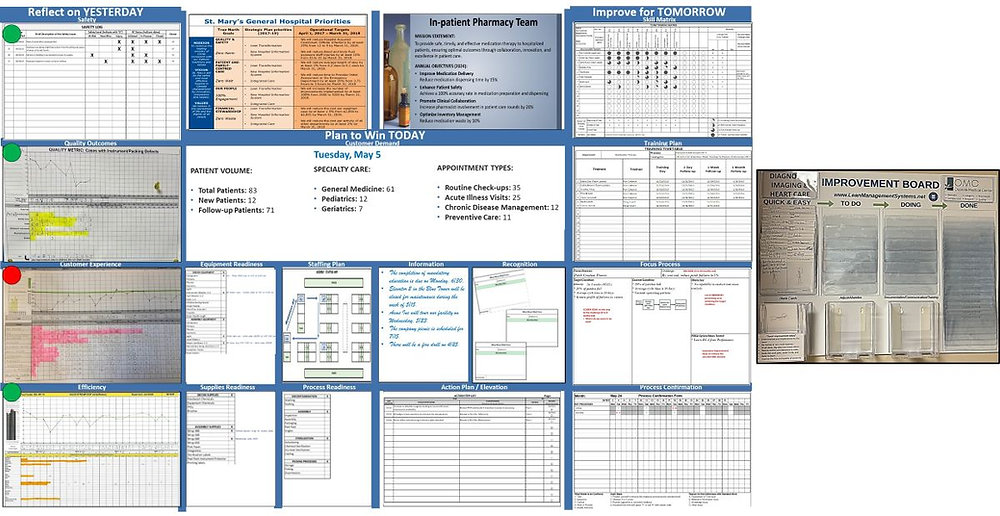
When used effectively, a huddle board helps teams:
Clarify how the team’s mission and improvement goals align with the organization’s purpose and annual objectives.
Reflect on the previous day’s performance to understand where promises were kept and where gaps appeared.
Expose the underlying causes of performance gaps.
Follow up on problem-solving activities and confirm whether countermeasures are working.
Plan for the day, ensuring clarity of priorities and expectations.
Confirm that the right resources are available to meet customer demand.
Support the development of team skills and capability.
Track progress toward improvement goals.
Escalate issues that the team cannot resolve on its own.
Celebrate wins and reinforce standards.
The power of the huddle board lies in its ability to make work, problems, and priorities visible. Its visual nature enables any observer to understand what matters to the team and what performance looks like today. When used well, the huddle board supports one of the foundational principles of operational excellence: respect for every individual. It gives every team member access to shared knowledge and the opportunity to participate in improving the system.
2. What Makes a Huddle Board Reflect System Strength?
A strong huddle board reflects a strong daily management system. To understand whether your board is functioning properly, consider these indicators:
a. Visual Clarity and Simplicity
Effective boards are focused, uncluttered, and standardized. They highlight essential metrics in formats that enable instant understanding. A viewer should be able to determine immediately whether commitments to customers are being met and whether performance is improving or declining.
b. Real-Time Relevance
An effective board reflects today’s conditions. It is updated daily, or more frequently, and evolves as the team learns. Metrics must be actionable, not historical.
c. Problem Visibility
Strong boards make problems impossible to ignore. Tags, notes, markers, or cards reveal where issues have occurred, what has been done, and whether escalation is required. This reinforces the idea that making problems visible is a strength, not a weakness.
d. Follow-Through and Learning
If problems appear but never change, the board becomes ceremonial. Strong boards show evidence of follow-up, confirmation of effectiveness, and captured learning. They demonstrate a team’s commitment to scientific thinking.
e. Team Engagement
A healthy board involves the entire team. Everyone should be able to explain at least part of what is displayed. When team members contribute, question, and engage, the board becomes a mechanism for shared responsibility and learning—not merely a management report.
3. Aligning System Behaviors with Operational Excellence Principles
Operational excellence is grounded in principles, not tools. The Shingo Model™ highlights principles such as respect for every individual, scientific thinking, quality at the source, and thinking systemically. A huddle board and its related routines either reinforce these principles or reveal gaps.
Here are examples of how board behaviors connect to principles:
Respect for Every Individual
The board provides transparency and invites contributions from all team members. It enables informed participation and encourages peer accountability.
Lead with Humility
Leaders who use the board to ask questions, listen, and learn demonstrate humility. They coach rather than dictate.
Seek Perfection
Boards that track performance gaps and support continuous improvement reinforce this principle.
Assure Quality at the Source
Daily visibility of defects or quality issues allows teams to contain problems immediately and prevent recurrence.
Flow and Pull Value
Boards that track flow metrics, takt time, inventory levels, or work-in-progress help teams focus on value delivery and waste reduction.
Think Systemically
Connection to upstream and downstream processes shows how one area’s problems affect the larger system.
Embrace Scientific Thinking
When boards display problem statements, hypotheses, countermeasures, and follow-up learning, they reinforce experimentation and evidence-based decision-making.
Focus on Process
Boards guide the discussion toward process performance rather than individual blame.
Create Constancy of Purpose
Boards help teams stay aligned with the mission, vision, and strategic goals of the organization.
Create Value for the Customer
Every metric should connect to customer value. Boards that highlight customer experience, reliability, safety, and flow create alignment with this principle.
4. Using the Huddle Board to Develop Capability
One of the most powerful roles of the huddle board is capability development—not just for frontline teams but for leaders as well. The board becomes a daily teaching tool.
Leaders can use it to:
Coach team members to recognize problems.
Practice root cause analysis.
Model proper escalation.
Reinforce leader standard work.
Celebrate disciplined problem-solving.
Capability development occurs in real time. Each huddle becomes a short workshop in Lean thinking, systems thinking, and disciplined execution. The best leaders rely on questions to drive this learning, such as:
What is the goal for this metric?
What is our performance today?
What is the primary cause of the performance gap?
What experiment did we run, and what did we learn?
What will we try next?
5. Diagnosing System Weakness Through the Board
A weak huddle board often reveals deeper system problems. Watch for these red flags:
The board is out of date or inconsistently updated.
Metrics do not reflect customer requirements.
The team does not understand what is being displayed.
Problems are hidden or ignored.
Escalation is discouraged or avoided.
Only managers interact with the board.
There is no connection between the board and the actual work of the team.
When these signs appear, the issue is not the board—it is the system. Leaders must reflect on their coaching habits, expectations, and the environment they create. The board is a mirror; it reflects behavior, culture, and discipline.
6. Making the Invisible Visible
The huddle board’s greatest strength is its ability to reveal what is invisible in most organizations: the state of the system, the degree of discipline, the presence of problems, and the level of engagement. But for this visibility to drive improvement, the board must be supported by tiered escalation, leader standard work, and structured coaching routines.
When fully integrated, the huddle board becomes a daily mechanism for aligning action with values and purpose. Over time, these routines evolve into habits that shape culture and strengthen organizational performance.
Conclusion: Elevating the Right Insights
If you stand in front of your huddle board today, what does it tell you about your system, your culture, and your leadership?
Does it reveal real-time performance?
Does it highlight where support is needed?
Does it demonstrate team problem-solving?
Does it reflect the principles of operational excellence?
Does it show evidence of learning and improvement?
If the answer is yes, your huddle board is not just tracking metrics—it is fueling capability, alignment, and excellence.
If not, now is the time to reflect. Ask your team what they see. Ask yourself what you reinforce. And return to the core question:
What insights does your huddle board provide about the strength of your daily management system and how well it supports system-driven behaviors aligned with the principles of operational excellence?
The answers are available for any organization ready to look closely.
Next Steps
If you want support strengthening your daily management routines or assessing the effectiveness of your huddle board, I can help. Daily systems are the heartbeat of operational excellence. Now is the time to ensure yours is strong, responsive, and designed to help your people and your organization thrive.
Comments