

Tiered Management: Ensuring Commitment and Accountability at Every Level
A few days ago, a healthcare executive reached out to me with a concern about their Tiered Management system. On the surface, the system was functioning—they had the meetings scheduled, the huddles in place, and the data flowing—but something was missing. They could see the mechanics of the system, but the sense of purpose, the underlying behaviors that make tiered management truly effective, had faded over time.
This scenario is all too common. Organizations implement Tiered Management systems, sometimes as a checkbox exercise, without fully anchoring the practice in its primary purpose: ensuring the organization consistently delivers on its commitments to customers, patients, and stakeholders. Without that focus, Tiered Management becomes a reporting mechanism rather than a dynamic management system, and the behaviors needed to sustain performance at the frontline weaken.
In this post, I will share insights on the real purpose of Tiered Management, why it often loses its effectiveness over time, and how leaders can re-establish its intent to support frontline teams while driving organizational accountability and learning.
Understanding the True Purpose of Tiered Management
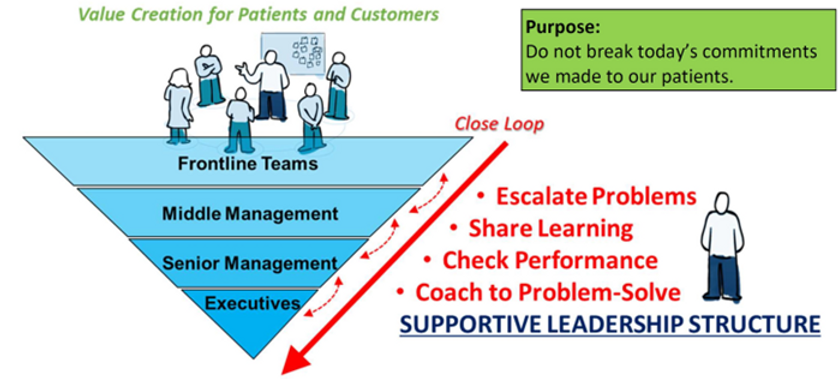
At its core, Tiered Management is not about collecting data or reporting metrics to satisfy a hierarchical structure. The system is designed to ensure that the organization does not fail its commitments. Every day, organizations make explicit or implicit promises—meeting patient care standards, delivering products on time, maintaining quality, and safeguarding compliance. Tiered Management exists to make sure those promises are met.
The system accomplishes this by creating structured, recurring connections across multiple levels of the organization. These connections are not just about reviewing numbers—they are about actively supporting the frontline teams responsible for delivering results. When executed properly, Tiered Management engages leaders at every level in solving problems, coaching, and removing obstacles that might prevent commitments from being fulfilled.
Why Tiered Management Often Fails
Even organizations with the best intentions can experience a drift in Tiered Management practices. In my experience, there are several common reasons this happens:
1. Losing Sight of Purpose:
Organizations often adopt Tiered Management because it is a recognized Lean tool or a best practice they have seen elsewhere. Over time, the meetings and huddles become rituals rather than purpose-driven activities. Leaders focus on filling in spreadsheets or generating reports rather than understanding whether the frontline has what it needs to succeed.
2. Focus Shifts to Hierarchical Reporting:
Tiered Management is intended to be customer and stakeholder-centric, but many organizations unintentionally shift it to a tool for hierarchical reporting. Leaders focus on checking boxes, verifying compliance, or preparing for audits instead of using the system to drive action. The result is disengagement at the frontline and a mechanical, rather than dynamic, system.
3. Weak Coaching Behaviors:
Tiered Management is a vehicle for developing problem-solving skills and coaching behaviors across the organization. Without leaders actively coaching and challenging their teams to think critically, the system becomes a data collection exercise instead of a learning and improvement cycle.
4. Lack of Escalation Discipline:
A critical function of Tiered Management is the structured escalation of problems that cannot be resolved at the frontline. When escalation rules are not followed or when leaders intervene inconsistently, issues linger longer than necessary, commitments are missed, and trust in the system erodes.
The Mechanics vs. the Purpose
It is easy to confuse the mechanics of Tiered Management with its purpose. The mechanics—scheduled huddles, metrics boards, escalation paths—are only tools. The purpose is to protect the organization’s promises and support the people doing the work.
Think of it like a car. The mechanics are the engine, steering, and brakes. They are necessary, but a car does not fulfill its purpose without a driver who knows where to go and why. Similarly, Tiered Management systems need leaders who understand why they exist and how to use them to influence performance, not just follow a schedule.
Re-centering Tiered Management Around Commitment
To make Tiered Management effective again, organizations must reconnect the system to its purpose: ensuring commitments are met. Here are steps to re-center the system:
1. Clarify Organizational Commitments:
Every leader, at every level, must understand what commitments the organization is making to its customers and stakeholders. In healthcare, these might include patient safety standards, timely discharge processes, or responsiveness to care requests. In manufacturing, it could be on-time delivery, quality targets, or safety standards. Once commitments are clear, leaders can align the Tiered Management system to protect those commitments.
2. Define Tiered Management Behaviors:
Leaders at all levels must understand what behaviors the system requires. These include:
- Coaching and developing problem-solving skills at the frontline
- Escalating issues that cannot be resolved locally
- Supporting teams in removing obstacles and providing necessary resources
- Reviewing performance with the purpose of action and improvement rather than reporting
Behavioral clarity ensures that the system is more than just a meeting schedule—it becomes a rhythm of engagement, learning, and accountability.
3. Engage the Frontline Actively:
The frontline is where commitments are delivered. Tiered Management should actively support their work, not add administrative burden. Meetings should be structured to identify obstacles, celebrate successes, and review critical metrics that directly impact the ability to meet commitments. Every discussion should answer the question: “How are we helping the frontline meet its promises today?”
4. Make Metrics Meaningful:
Metrics should be actionable, timely, and directly tied to organizational commitments. Overloading leaders with irrelevant or delayed data creates noise and dilutes focus. Focus on the few key indicators that matter most to customers, patients, and the business.
5. Escalate with Discipline:
A hallmark of effective Tiered Management is disciplined escalation. Problems that cannot be resolved at one level must be escalated systematically, with clear accountability and follow-up. This ensures that the system drives rapid problem resolution rather than stagnating at one level.
Coaching Through Tiered Management
One of the most overlooked aspects of Tiered Management is its role as a coaching tool. A well-functioning system develops leaders at every level by teaching them to identify problems, test solutions, and learn from results.
Coaching in this context is not about giving answers. It is about asking questions that guide teams to think critically, understand root causes, and experiment with solutions. Leaders should model problem-solving behaviors themselves, creating a culture where learning is continuous and improvement is embedded in daily work.
For example, in a hospital setting, a nurse manager might notice repeated delays in lab results impacting patient flow. Through Tiered Management huddles, the leader can guide the team to identify bottlenecks, test changes, and track improvements—all while building problem-solving capability across the team.
Sustaining Tiered Management
Implementing or re-aligning Tiered Management is not a one-time activity. Sustaining its effectiveness requires continuous attention to purpose, behaviors, and outcomes. Here are practices I have seen work well in both healthcare and manufacturing:
1. Regular Leader Reflection:
Leaders should reflect on whether Tiered Management meetings are helping the organization keep its commitments. This reflection includes asking: Are we identifying obstacles early? Are issues being escalated appropriately? Are teams getting the support they need?
2. Training and Development:
Even experienced leaders benefit from ongoing development in coaching, problem-solving, and escalation discipline. Structured training ensures that leaders do not revert to mechanical reporting behaviors.
3. Visual Management:
Clear, visual boards that display the most critical commitments and issues can focus attention and provide transparency across the organization. These boards should highlight problems that need immediate action rather than historical data.
4. Celebrate Learning and Success:
Tiered Management should acknowledge and celebrate when teams solve problems, improve performance, or exceed expectations. Recognition reinforces behaviors and strengthens engagement.
5. Periodic System Audits:
Organizations should periodically assess whether Tiered Management is achieving its purpose. This is not about compliance—it is about effectiveness. Do the meetings and escalations lead to fewer broken commitments? Are leaders coaching effectively? Are teams empowered to act?
Tiered Management as a Strategic Advantage
When executed well, Tiered Management becomes more than a Lean tool—it becomes a strategic advantage. Organizations with strong Tiered Management systems:
- Reduce variability and risk by identifying issues before they affect customers
- Build leadership capability at every level
- Increase organizational alignment and engagement
- Create a culture where problem-solving and continuous improvement are embedded in daily work
In essence, Tiered Management is a living system. It requires leaders to remain purpose-driven, focused on the frontline, and disciplined in behaviors. When these elements are in place, the system ensures that commitments are consistently met, creating reliability and trust with customers and stakeholders.
Practical Steps to Re-establish Tiered Management
For organizations looking to strengthen or re-align Tiered Management, here is a practical approach I often use with clients:
- Revisit the Purpose: Host a leadership session to clarify the system’s intent and link it directly to organizational commitments.
- Define Key Metrics: Identify the few metrics that reflect the health of the organization’s commitments, not simply internal efficiency.
- Map Escalation Paths: Ensure that every problem has a clear resolution path and accountability.
- Train Leaders: Conduct workshops to reinforce coaching behaviors, problem-solving methods, and effective meeting facilitation.
- Audit and Adjust: Use regular check-ins to ensure the system remains effective and purpose-driven. Adjust as necessary to respond to evolving challenges.
This approach ensures Tiered Management is not static—it evolves with the organization while remaining anchored to its primary purpose.
Conclusion
Tiered Management is often misunderstood as a mechanical process of reporting and data review. In reality, its true purpose is far more strategic: protecting organizational commitments, supporting frontline teams, and developing leaders at every level.
The effectiveness of Tiered Management depends on connecting the mechanics to their intended purpose, instilling disciplined behaviors, and maintaining engagement across all levels. Leaders must focus on coaching, timely problem-solving, and escalation, always with the lens of ensuring commitments are met.
Organizations that successfully re-align Tiered Management find that it becomes a powerful tool for building capability, driving reliability, and creating a culture of continuous improvement. It is not just a system—it is a reflection of how seriously an organization takes its promises and how committed it is to delivering results every day.
By keeping Tiered Management purpose-driven, behaviorally anchored, and focused on the frontline, organizations can ensure they do not merely follow a process, but truly meet their commitments, strengthen trust with customers and stakeholders, and drive sustainable excellence.
Comments