

How a Lean Management System Connects People, Processes, and Results
When I look back at my time leading the Andersen Management System (AMS) at Andersen Windows beginning in 2008, one insight remains as relevant today as it was then: organizations do not achieve better results simply by working harder. They achieve better results by building a management system that consistently develops people, improves processes, and aligns daily actions with long-term goals.
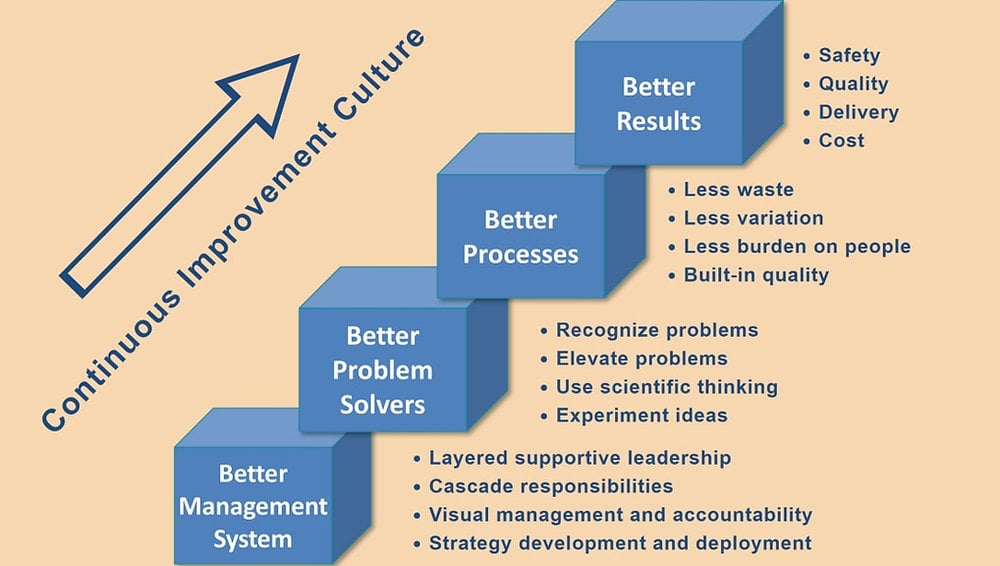
As I worked with teams across manufacturing, engineering, and operations, I created a model to explain how the management system connects to results. George Box famously said, “All models are wrong, but some are useful.” This model was useful. It helped leaders across the company see how Lean principles translated into daily behaviors and long-term performance. It clarified why we needed to redesign the way we managed work, not just the work itself. And it may be just as useful for other organizations trying to build a high-performance operating system.
This post explains that model in detail—what it means, how it works, and why building a mature management system is fundamental to achieving sustainable gains in quality, cost, delivery, safety, and workforce engagement.
Why Results Depend on More Than Effort
Every organization wants better results. Whether you produce medical devices, windows, food products, or deliver healthcare or professional services, customers expect continual improvement. They want shorter lead times, higher reliability, fewer errors, better experiences, and a level of value that increases year after year.
Organizations often respond to customer expectations with initiatives, projects, or bursts of improvement activity. While these efforts may create temporary gains, they rarely produce lasting improvement. When gains fade, teams try harder, push more, and work longer hours, yet the outcomes return to previous levels.
The missing link is the management system.
Effort without a system is not sustainable. Tools without a system are not aligned. Improvements without a system are not reinforced. A Lean management system provides the structure, clarity, and routines that allow improvement to take hold and become part of the organization’s DNA.
This model begins with an essential idea: results cannot improve unless processes improve, and processes cannot improve unless people improve their capability to solve problems. People cannot develop unless the management system creates the conditions for learning, experimentation, alignment, and daily problem-solving.
Everything is connected.
Better Results Require Better Products and Services
Organizations compete on value. Whether customers express it directly or indirectly, value usually falls into three universal dimensions:
- Better quality and reliability
- Faster and more predictable delivery
- Lower total cost
Some industries emphasize one dimension over another, but the underlying dynamic is the same: customer expectations rise, complexity increases, and competition intensifies. Standing still is not an option.
The only enduring strategy is continuous improvement.
But better results do not appear by telling teams to “do better” or demanding improvements without giving people the tools and environment required to achieve them. Better results emerge from better processes—designed, tested, and continually improved by the people who do the work.
Better Products and Services Require Better Processes
Behind every consistently high-quality product or service is a disciplined process. Behind every recurring defect or delay are weaknesses in the process.
Organizations sometimes fall into the trap of believing problems stem primarily from individuals—their skills, discipline, motivation, or experience. But in Lean thinking, the process is the key variable. If you want better outcomes, you must improve the processes that produce them.
Improving processes means:
- Eliminating waste
- Reducing variationBuilding quality into the work itself
- Strengthening handoffs and communication
- Removing unnecessary burden from employees
- Creating flow and predictability
- Establishing clear expectations and standards
Designed well, processes deliver reliable outcomes. Designed poorly, even the most dedicated teams struggle.
In many organizations, processes are inconsistent across shifts or locations, heavily reliant on tribal knowledge, or shaped by workarounds rather than intent. People compensate for these weaknesses every day, often without realizing how much variation or hidden waste undermines performance.
Process improvement requires a workforce of problem solvers.
Better Processes Require People Who Can Solve Problems
Lean organizations are learning organizations. That means employees at every level—from the front line to senior leadership—practice the scientific method as part of their daily work.
When every employee becomes a problem solver, something powerful happens:
- Small issues are identified before they grow
- Waste is removed systematically rather than temporarily
- Experiments generate new learning
- Capabilities increase across the organization
- Teams take ownership of performance
- Change becomes the norm, not the exception
This is not theoretical. It is practical, disciplined, hands-on problem-solving grounded in PDCA (Plan-Do-Check-Act):
- Define the problem
- Understand current conditions
- Identify root causes
- Test countermeasures
- Check the impact
- Adjust and learn
People learn by doing, by testing hypotheses, by sharing discoveries across teams, and by using each problem as an opportunity to improve not just results but capability.
Over time, this daily learning compounds. It becomes cultural muscle memory. The organization becomes more adaptive, resilient, and aligned. It becomes capable of responding to new customer expectations, economic pressures, labor shortages, or supply chain disruptions without losing performance.
But this learning does not occur automatically. It requires structure, clarity, routines, and leadership support. That is the role of the management system.
Better People Development Requires a Better Management System
The management system is the foundation that allows people to learn and improve processes in a disciplined, consistent, sustainable way.
Without a management system:
- Improvement relies on a few motivated individuals
- Results vary between teams, units, or shifts
- Problems remain hidden until they become crises
- Leaders spend their time firefighting rather than developing people
- Gains fade as soon as priorities shift
A Lean management system eliminates those obstacles by creating standard methods for planning, executing, reviewing, and improving work. It connects strategy to daily work. It ensures teams understand expectations, spot problems quickly, and have the support needed to solve them.
A mature management system includes:
- Daily management routines
- Visual management and visual controls
- Standard work for leaders at all levels
- Tiered huddles and problem escalation
- Coaching cycles
- PDCA problem-solving structures
- Strategy deployment (Hoshin Kanri)
- Clear alignment between goals, processes, and behaviors
When designed well, the management system becomes the operating framework for the entire organization. It reduces dependency on individual leaders, removes the reliance on tribal knowledge, and ensures that good habits persist regardless of who is in the role.
It also helps leaders shift from directing and firefighting to coaching and developing. That cultural shift is essential. A management system is only as strong as the leadership behaviors that reinforce it.
What Happens When the Management System Matures
As Lean management practices take root, several changes become visible across the organization.
Scientific Thinking Becomes the Norm
Teams use structured problem-solving rather than jumping to conclusions or relying on assumptions. Leaders ask better questions. Discussions center on facts, not opinions. Decisions are tested, not debated endlessly.
Visual Management Reduces Complexity
When teams can see performance, workload, expectations, and abnormalities, they can act quickly and confidently. Work becomes more predictable. Problems surface earlier. Hand-offs improve dramatically.
Supportive Leadership Replaces Command-and-Control
Leaders spend more time at the gemba. They coach, mentor, and remove barriers. They help teams learn rather than telling them what to do. People feel supported rather than supervised.
Continuous Improvement Becomes Daily Behavior
Instead of improvement projects being isolated events, improvement becomes part of the work. Small, frequent, methodical PDCA cycles build momentum. Teams generate their own solutions. Ownership and pride increase.
Results Improve Across the Board
With better processes and stronger problem-solving capability, organizations deliver better quality, shorter lead times, lower costs, and improved customer experiences. Engagement increases. Turnover decreases. The organization performs at a level previously considered out of reach.
This is not wishful thinking. It is a pattern observed across industries when organizations invest in a management system that supports people and processes. The system is the enabler. The people are the engine. The processes are the pathway.
Why This Model Still Matters Today
The model I developed in 2008 helped explain Lean in a way that resonated with leaders and teams across Andersen Windows. But it was not specific to that organization. It was based on principles that apply universally.
Today, the same model helps organizations struggling with:
- Staff shortages
- Quality variation
- Increasing customer expectations
- Operational complexity
- Lack of alignment
- Recurring problems
- Burnout and disengagement
- Slow improvement cycles
Many organizations try to improve results without investing in their management system, or they improve processes without developing their people, or they develop people without connecting the work to strategy. This model helps explain why those efforts fall short.
Every part of the system must reinforce the others. When aligned, the organization performs with remarkable consistency. When disconnected, even the best efforts struggle.
Final Thoughts
A Lean management system is not a collection of tools. It is a way of operating. It shapes how leaders lead, how people learn, how processes work, and how results are achieved. It provides the foundation for building a culture of continuous improvement that sustains itself over time.
When organizations invest in a management system that develops people, improves processes, and connects daily work to strategic goals, they unlock performance levels they never thought possible. The benefits compound year after year. The organization becomes more resilient, more agile, and more capable of delivering superior value to its customers.
This model proved useful at Andersen Windows, and it continues to be useful in my work with clients today. If your organization is seeking better results, start by strengthening the foundation—your management system. Everything else grows from there.
If you'd like help developing or refining your management system, I’d be happy to start a conversation.
Comments