

Leader Standard Work: Why Structure Unlocks Creativity
One of the most persistent myths about Leader Standard Work (LSW) is that it stifles creativity. I hear it often: “It kills innovation. It makes leadership rigid.” I understand the reaction. The word standard can conjure images of dusty binders, checklists, and mechanical routines. It sounds inflexible, controlling, and antithetical to the idea of creative thinking.
But that perspective misses the point entirely. True creativity does not flourish in chaos. It thrives in clarity. It grows in an environment where priorities are clear, where leaders are grounded in reality, and where structure creates space for thought and reflection. That is precisely what Leader Standard Work provides.
The Paradox of Freedom: How Routine Enables Innovation
Many leaders intuitively feel that routines constrain freedom. Yet, in my experience, the opposite is true. Most leaders are overwhelmed by a relentless flow of urgent tasks, overflowing inboxes, and constant interruptions. In this state, creativity is pushed to the margins, postponed indefinitely, or forgotten entirely.
Leader Standard Work introduces a rhythm that restores control over time and attention. It is not a checklist designed to make leadership mechanical; it is a framework that creates breathing room. When practiced with purpose, LSW allows leaders to:
- Align their calendars to focus on what truly matters, not just what is urgent.
- Begin their day intentionally, rather than reacting to emails or crises.
- Show up consistently where value is created, not just where noise is loudest.
With the distractions managed, leaders regain mental bandwidth. They start asking better questions, thinking strategically, and noticing opportunities that had previously gone unseen. Structure becomes the enabler of innovation, not its enemy.
Living LSW: My Experience as a Plant Manager
I did not learn LSW from a textbook—I lived it as a plant manager. It was not a theory for me; it was an anchor. My mornings were intentionally structured to maximize awareness, presence, and reflection.
Each day began at 6:45 a.m. I would power on my computer but deliberately avoid email. Checking messages first is a trap that pulls you into someone else’s agenda before the day even begins. Instead, I started with a Gemba walk—my daily route through the plant. I visited Tier 1 boards, flow lanes, Kanban cards, and preventive maintenance visuals. I connected with the third shift team. These interactions were not about oversight or inspection—they were about presence, understanding, and respect. Sometimes we discussed the work; other times it was just a simple greeting.
The Gemba walk provided real-time context: What is moving well? Where are we encountering obstacles? Which issues need attention? That rhythm—observe, reflect, act—grounded my day and informed every decision that followed.
By 7:15 a.m., I returned to my desk, took notes, and reflected on what I had seen. Only then did I engage with emails, and even then, selectively. Prioritization, not reactivity, guided my actions.
At 8:00 a.m., the plant leadership team gathered for our Tier 4 meeting. Everyone came prepared to discuss escalations, operational challenges, and improvement opportunities. This was not status reporting. This was collaborative problem-solving.
By 8:30 a.m., we returned to the floor as a team. Each day, we focused on a different area, walked Gemba, reviewed Tier 2 boards, and aligned strategy with reality. That rhythm—structured observation, reflection, and action—was where many of my best ideas emerged. Not in a formal brainstorming session, but embedded in the work itself.
Why the Most Creative Leaders Use Systems
When I reflect on the most creative leaders I have worked with, one common trait stands out: they operate within a system. They do not leave leadership to chance. They create routines that provide both focus and freedom.
- They walk the floor at consistent times—not out of habit, but to maintain visibility and connection.
- They carve out time for reflection, recognizing that learning does not happen by accident.
- They coach regularly, intentionally, and consistently.
Leader Standard Work becomes more than a tool—it becomes a personal operating system. It helps leaders stay grounded in purpose, aligned with strategy, and connected to their teams.
Jazz, Structure, and Leadership
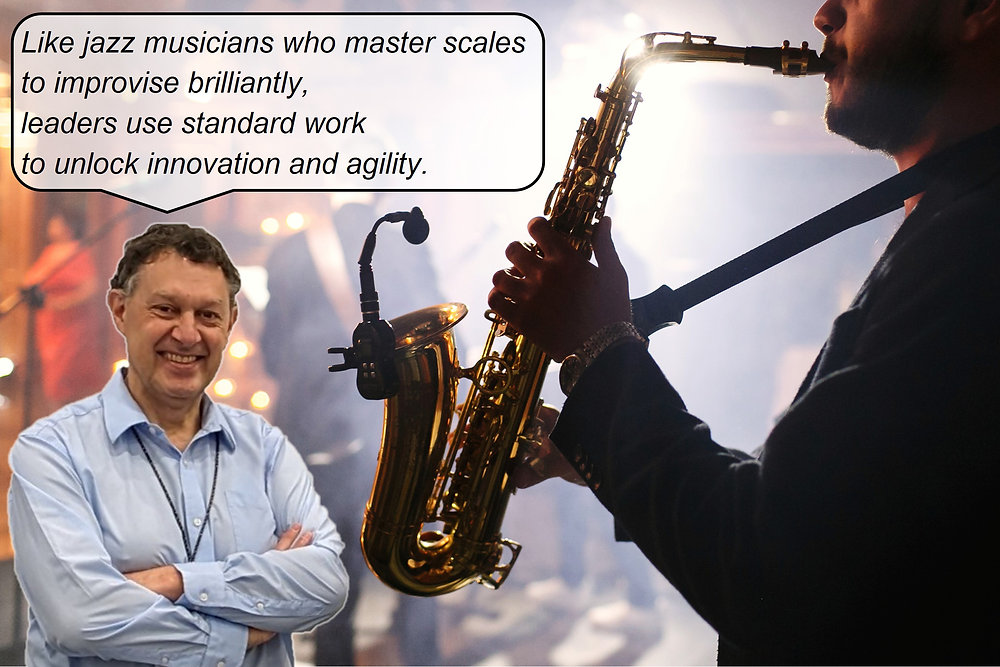
If you are skeptical that structure and creativity can coexist, consider jazz. I first listened to Charlie Parker in the late 1990s, and the music stayed with me. Jazz musicians do not play randomly. They internalize the scales and rhythm, and improvisation happens within the framework.
Leader Standard Work functions the same way. It establishes a baseline rhythm, a tempo for leadership. From that foundation, leaders can improvise thoughtfully, respond to challenges with clarity, and lead with intention rather than reactivity. Structure does not limit innovation; it sets the conditions for it to flourish.
What Happens Without LSW
Over the years, I have coached dozens of intelligent, dedicated leaders. Early in our conversations, they often say:
- “I end most days wondering what I actually accomplished.”
- “My best ideas come when I’m on vacation.”
- “I want to coach more, but there’s never time.”
- “I forget to follow up on commitments.”
These comments do not reflect personal failings. They reflect a lack of system. Without structure, even the most capable leaders are trapped in reactive cycles. Creativity cannot emerge because the space for it does not exist.
Starting Small: Practical Steps
Leader Standard Work does not require a formal program to begin. Small, consistent habits can create the structure needed for leadership and creativity to thrive:
- Start the day in Gemba: Observe, listen, and ask a thoughtful question. Follow the same route to create consistency.
- Reflect at day’s end: Take 15 minutes to review what went well, where you drifted, and what to adjust tomorrow.
- Choose a recurring coaching question: Ask team members a simple, consistent question like, “What’s one thing you learned this week?” Repetition builds trust and engagement.
These practices create rhythm, and rhythm invites clarity, focus, and thoughtful leadership.
What Makes LSW Effective
From my experience, LSW works best when it is:
- Visible: Track routines on a whiteboard, in a notebook, or on a card. Visibility reinforces accountability.
- Intentional: Link routines directly to goals, strategy, and team development.
- Evolving: Learn, adjust, and refine routines over time. LSW is not static—it grows with the leader and the organization.
My own early routines were far from perfect. Some days were too rigid, others too loose. But consistency built capability. My team gained clarity, problems were detected earlier, delegation improved, and I found time to think forward rather than react. That is when leadership transformed.
LSW Is an Act of Respect
Across industries—manufacturing, healthcare, and services—I have observed the same pattern. Without structure, leaders react. With it, they lead.
Leader Standard Work is not about control. It is about respect:
- Respect for the people doing the work.
- Respect for the systems we are trying to improve.
- Respect for ourselves as leaders.
Those early Gemba walks at 6:45 a.m. were not about checking boxes—they were about presence, connection, and partnership. They reinforced that every voice mattered and every contribution counted.
Final Thought: Structure Reveals, It Does Not Restrain
Leader Standard Work does not make you robotic. It makes you intentional. It does not limit creativity. It creates the conditions for thoughtful leadership, reflection, and innovation.
One executive summed it up after six months of practicing LSW:
“I used to chase the urgent and miss the meaningful. Now I can see both, and I choose better.”
That is the power of rhythm. That is the freedom structure brings.
Comments