

Real-Time Decisions Start at the Gemba: Seeing, Thinking, Deciding
In many organizations, leaders make decisions from offices, relying on reports, dashboards, and delayed data. While convenient, this approach slows understanding and often obscures the real issues. The truth is simple: all data needed for decisions exists at the point of work, in real time. Leaders must go there. Offices delay the truth; Gemba walks reveal it.
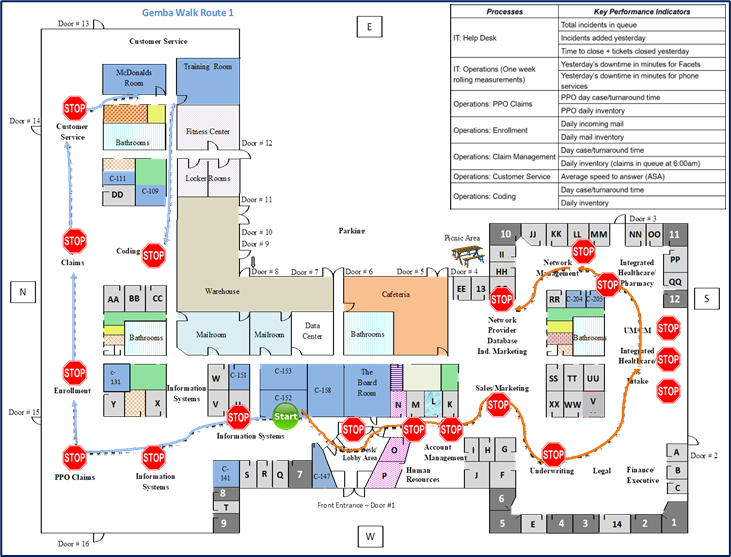
Case Study: Transforming Leadership at an Insurance Company
An insurance company president faced a familiar challenge: decisions were delayed, alignment was low, and problems escalated without resolution. Traditional office-based leadership relied on email reports and periodic meetings, resulting in long decision cycles and limited visibility into operational realities.
To address this, the president adopted a structured Gemba approach:
- Two Gemba routes defined, each with 12 stops covering value-creating areas
- Daily visual KPIs at each stop for immediate insight
- Weekly leadership walks per route, strictly observing and coaching, without laptops or reports
The result: leaders saw the real work, interacted directly with teams, and made timely, informed decisions.
Step 1: Build Visual KPI Boards
Visual management is at the heart of real-time leadership. KPI boards display essential metrics where the work happens. Each stop should have no more than five KPIs, updated daily, and co-created with the team.
| KPI | Target | Visual | Update Frequency |
|---|---|---|---|
| Claims Processed | 120/day | Bar chart + run chart | Daily |
| Error Rate | <2% | Red/Yellow/Green | Daily |
| Cycle Time | <4 hours | Histogram | Daily |
| Team Mood | Positive/Neutral/Concerned | Magnet system | Daily |
| Open Actions | <3 | Sticky notes | Live |
Key Rules for KPI Boards:
- Hand-drawn is acceptable; clarity matters more than perfection
- Teams update boards daily; this creates ownership
- Limit to 5 KPIs to maintain focus and clarity
Step 2: Define Leader Standard Work (LSW) for Gemba
Leader Standard Work ensures consistency and discipline in visits. A typical weekly schedule for a leader walking one route:
| Time per Stop | Action |
|---|---|
| 1 min | Check KPIs against targets |
| 2 min | Ask, “What’s blocking you?” |
| 2 min | Support problem-solving |
| 1 min | Recognize effort and successes |
Key Principles: No laptops. No reports. Just go, see, ask, listen, coach, and acknowledge.
Step 3: Gemba Walk Flow (6 Minutes per Stop)
Leaders follow a structured flow to maximize engagement and insight:
- Observe: Stand silently and read the board.
- Ask: “What do the numbers tell us?”
- Listen: Allow the frontline team to explain challenges.
- Coach: “What is one idea to improve?”
- Decide: Capture actions, assign owners, and set dates.
- Thank: Acknowledge contributions to reinforce engagement.
Outcomes After Six Months
| Metric | Before | After |
|---|---|---|
| Decision lag | 5 days | <24 hours |
| Leadership alignment | 41% | 85% |
| Problems escalated | 28/week | 4/week |
| Ideas implemented | 3/month | 19/month |
| Employee trust score | 62% | 89% |
This case demonstrates how real-time visibility and disciplined leadership significantly accelerate decision-making, improve alignment, and enhance employee trust.
Step 4: How to Build Your System
1. Map Your Gemba (1 Week)
- Identify all value-creating areas.
- Select 2 routes with 10–14 stops total.
- Assign one leader per route per week to ensure coverage.
2. Design KPI Boards (1 Week)
- Co-create with teams for relevance and buy-in.
- Apply the V.I.T.A.L. filter: visible, important, timely, actionable, limited.
- Install physical boards at the point of work.
3. Train Leaders (2 Hours)
- Role-play Gemba walks to practice observation, asking, and coaching.
- Teach leaders to support problem-solving rather than direct it.
- Practice assigning and following up on actions using sticky notes.
4. Launch & Audit (Weekly)
| Week | Focus |
|---|---|
| 1 | Observe only |
| 2 | Begin asking questions |
| 3 | Add coaching and actions |
| 4 | Review sticky notes, adjust as needed |
Audit Tool:
- Are all KPIs updated daily?
- Are there fewer than three open actions per stop?
- Did the leader ask more than tell?
- Was recognition given where appropriate?
Common Failures and Fixes
| Failure | Fix |
|---|---|
| Leaders bring laptops | Ban devices during walks |
| Teams hide problems | Praise “red flags” and transparency |
| KPIs not updated | Make board updates the team’s first task of the day |
| Actions stall | Leader owns follow-up accountability |
Scaling Beyond One Site
| Level | Structure |
|---|---|
| Site | 2 routes, weekly Gemba walks |
| Region | Monthly cross-site Gemba reviews |
| Executive | Quarterly “President’s Route” with all stops |
Scaling ensures that the practice of going to the work and making real-time decisions becomes systemic, not limited to a single site or leader.
30-Day Launch Plan
| Week | Action |
|---|---|
| 1 | Map routes, select stops |
| 2 | Build 3 pilot KPI boards |
| 3 | Train leaders and run the first walk |
| 4 | Audit, adjust, and expand |
The Core Framework: SEE → THINK → DECIDE
- SEE: Observe visual KPIs at the Gemba without interference.
- THINK: Leaders and teams interpret the data collaboratively.
- DECIDE: Take action, assign owners, and set completion dates.
This structured approach eliminates delays, removes filters, and ensures leadership sees reality directly.
Why This Works
- Immediate Visibility: Real-time KPIs expose issues as they happen.
- Leader Engagement: Leaders understand daily operational challenges, not just monthly metrics.
- Team Accountability: Teams own updates and actions, creating engagement and ownership.
- Faster Decisions: Reduced lag between issue identification and resolution.
- Sustainable Improvement: Continuous coaching embeds Lean thinking into daily routines.
Your Turn: Applying Gemba in Your Organization
Consider your own operational environment:
- What is one critical stop you will add this week?
- Which KPI will you track there?
- Who will own the follow-up and improvement?
Answering these questions is the first step toward building a real-time, visible, and accountable leadership system.
By moving leadership out of offices and onto the Gemba, organizations ensure that decisions are based on facts, problems are solved promptly, and improvement becomes continuous.
Comments