

Closing the Gap: Driving Effective Daily Huddles Through Behavioral Assessment
Recently, a senior leader asked me to provide feedback on their frontline huddles. At first, I felt honored by the request—but also challenged. What exactly did they expect from their huddles? Were the huddles intended simply as a review of metrics, or were they meant to shape specific behaviors and reinforce organizational habits? Understanding the purpose of huddles is critical because their effectiveness is not measured by attendance alone—it is measured by the behaviors they cultivate and the outcomes they drive.
In my experience, organizations often struggle with frontline huddles not because teams fail to show up, but because the desired behaviors of leaders and participants are unclear or inconsistent. Without clarity, huddles risk becoming routine reporting sessions, disconnected from improvement, accountability, and problem-solving.
Understanding the Purpose of Huddles
Huddles are more than meetings. They are behavioral levers that influence how teams think, act, and collaborate. A well-designed huddle system reinforces desired behaviors such as:
- Proactive problem identification: Teams spot deviations from expected performance before they escalate.
- Structured problem-solving: Frontline employees use facts, data, and structured thinking to address issues.
- Collaboration and accountability: Teams work together to prioritize actions and hold each other accountable.
- Alignment to organizational goals: Daily work is connected to broader objectives, ensuring each action contributes to strategic outcomes.
- Continuous learning: Teams reflect on experiments, recognize learning, and iterate quickly.
By clearly defining these behaviors, organizations can measure the gap between actual and desired behaviors and take deliberate actions to close it.
Behavioral Assessment: A Tool for Measuring Huddle Effectiveness
Measuring huddle performance through metrics like attendance or number of issues discussed only scratches the surface. To truly understand effectiveness, we need to observe and assess behaviors—both of the team and the leader facilitating the huddle.
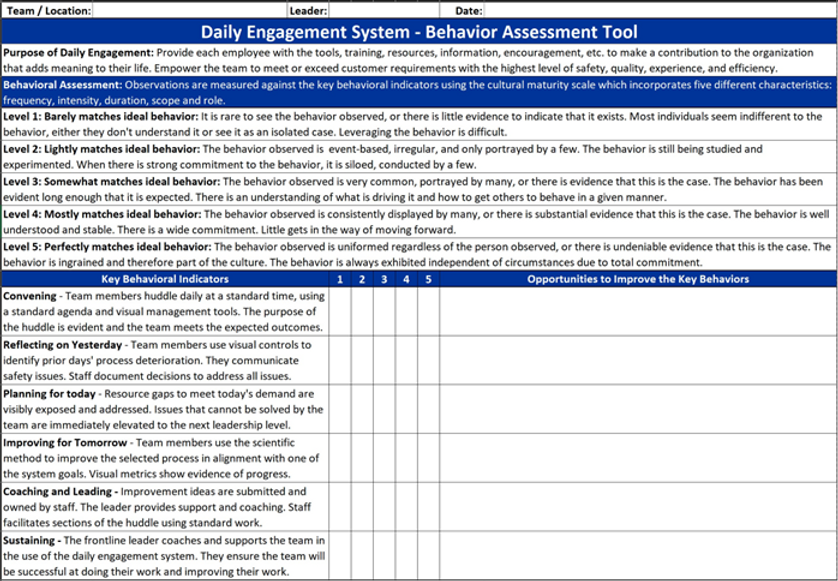
One approach I have used extensively is a behavioral assessment tool within the Daily Engagement System (DES). This tool identifies expected behaviors, tracks their occurrence, and highlights gaps that limit huddle effectiveness.
Step 1: Define Desired Behaviors
The first step is to articulate what “success” looks like in a huddle. For example:
Leader Behaviors:
- Arrives prepared with clear objectives.
- Facilitates discussion without dominating.
- Encourages questioning and curiosity.
- Reinforces alignment to operational goals.
- Coached problem-solving instead of providing immediate answers.
Team Behaviors:
- Shares accurate, timely information.
- Identifies issues proactively.
- Suggests potential countermeasures or experiments.
- Engages respectfully with peers.
- Prioritizes work based on system needs rather than individual preferences.
Clearly defining these behaviors sets the foundation for observation and measurement.
Step 2: Observe Current Behaviors
Observation must be systematic and consistent. Ideally, an observer records behaviors during multiple huddles to identify patterns rather than isolated events. Key questions include:
- Are the behaviors of leaders and team members aligned with expectations?
- Are issues raised in a structured way with data and facts?
- Is problem-solving collaborative or reactive?
- Are actions linked to measurable outcomes?
In my experience, observing even one huddle can reveal insights about the rhythm, engagement, and focus of the team. Over time, repeated observation builds a dataset that identifies both strengths and gaps.
Step 3: Measure the Behavioral Gap
Once desired and actual behaviors are documented, we can quantify the gap. For example:
- Problem identification: If the desired behavior is to identify at least one process deviation per huddle, but teams report none or only react to urgent issues, a gap exists.
- Leader coaching: If leaders rarely ask guiding questions, teams may default to passive reporting rather than structured problem-solving.
- Alignment: If metrics are discussed without linking to organizational goals, the huddle may not reinforce strategic alignment.
Quantifying these gaps allows leaders to target improvements intentionally, rather than assuming the huddle is functioning effectively.
Step 4: Conduct Tests of Change
Behavioral gaps can be addressed through structured experiments. Using a Plan-Do-Check-Act (PDCA) approach:
- Plan: Select a specific behavior to improve, such as leader questioning techniques or team engagement in problem-solving.
- Do: Implement a change in one huddle—e.g., introduce a question template or a visual board for issue tracking.
- Check: Observe and document whether the change influenced the desired behaviors.
- Act: Standardize the successful change, or iterate with another experiment if results were limited.
Over time, these small tests of change build capability and reinforce a culture of continuous improvement within huddles.
Step 5: Sustain Improvement
Once behavioral improvements are observed, sustaining them requires leader standard work and structured reinforcement. Leaders must:
- Participate consistently in huddles.
- Model the desired behaviors daily.
- Coach team members on structured problem-solving.
- Review and reflect on the effectiveness of huddles regularly.
Teams, in turn, internalize the behaviors, making effective huddles self-sustaining rather than leader-dependent.
Case Example: Manufacturing Frontline Huddles
At a mid-sized manufacturing plant, I applied this approach to the frontline huddles. Initially, huddles were conducted faithfully, but issues persisted—production delays, quality defects, and reactive decision-making were common.
By using a behavioral assessment tool:
- We defined leader and team behaviors for each huddle.
- Observed several sessions and recorded behavioral gaps.
- Focused on improving leader coaching and team proactive problem identification.
- Conducted small tests of change, such as structured questioning and visual issue boards.
Within six weeks, observable improvements included:
- Teams consistently identified process deviations early.
- Leaders facilitated discussion without dominating.
- Problem-solving shifted from reactive to structured experiments.
- Actions from huddles were tracked to completion.
The result was measurable performance improvement and increased engagement. Huddles became a critical vehicle for sustaining continuous improvement rather than a ritualized reporting session.
Case Example: Healthcare Daily Huddles
In a hospital setting, nurse managers and department heads conducted daily patient flow huddles. Metrics were reviewed, but bottlenecks persisted, and staff were disengaged.
By defining desired behaviors—such as collaborative problem-solving, linking issues to patient outcomes, and escalating challenges appropriately—we:
- Assessed current behaviors during huddles.
- Introduced small changes, including structured question prompts and visual boards.
- Tracked the number of issues proactively identified versus reactive reporting.
- Coached leaders to facilitate learning rather than provide immediate solutions.
Within four months, huddle effectiveness improved dramatically:
- Patient flow issues were identified and addressed proactively.
- Leaders and staff engaged in structured problem-solving.
- Communication across shifts and departments improved, leading to faster resolution of delays.
Behavioral assessment made the difference—it highlighted where huddles were not influencing the desired actions and provided a path to measurable improvement.
Key Takeaways for Effective Huddles
- Define Desired Behaviors First: Huddles are tools to reinforce specific behaviors; clarity on what is expected is critical.
- Measure Behaviors, Not Attendance: Engagement and problem-solving are more important than simply showing up.
- Test Changes Iteratively: Small experiments can address gaps and build capability incrementally.
- Sustain Through Leader Standard Work: Leaders must model, coach, and reinforce desired behaviors consistently.
- Link to System Goals: Every action identified in the huddle should connect to operational and strategic objectives.
Conclusion: From Huddles to Continuous Improvement
Daily huddles are powerful mechanisms for driving continuous improvement—but only if they are behaviorally intentional. Observing, measuring, and closing gaps in behaviors ensures that huddles move beyond data review to engaged problem-solving, learning, and alignment.
Behavioral assessment transforms huddles into a lever for operational excellence. It allows leaders to focus on coaching and capability building, rather than assuming huddles are effective by default. When executed properly, huddles become a living system, reinforcing the organization’s culture, aligning daily work to goals, and embedding continuous improvement into the DNA of the organization.
By systematically identifying behavioral gaps, testing changes, and reinforcing leader and team behaviors, organizations create huddles that not only monitor performance but actively drive improvement. This is how frontline engagement becomes both measurable and sustainable, ultimately strengthening the system as a whole.
Comments