

Leaders Coaching Leaders: Building a Culture of Continuous Growth
In any organization striving for operational excellence, leadership capability is the defining factor. Systems, tools, and improvement routines matter—but the true engine of sustained performance is how leaders develop people and, in turn, how leaders themselves are developed. This is the premise behind the “Leaders Coaching Leaders” framework, a structured approach where leaders at all levels actively mentor and develop one another.
Unlike one-off training sessions or occasional workshops, this framework embeds coaching into daily operations, ensuring that learning happens in real time—where it matters most, at the front line of work. By creating a cascading system of coaching, organizations build both leadership capability and a culture where problem-solving, collaboration, and continuous improvement become second nature.
The Concept: Why Leaders Coaching Leaders Matters
Leadership development is often treated as a separate initiative—training courses, executive retreats, or annual performance reviews. While valuable, these methods fall short of creating sustainable change. True capability grows when leaders are coached in the context of their daily work, facing real challenges and making real decisions.
The Leaders Coaching Leaders framework establishes a structured, repeatable method for mentoring and capability building, ensuring that leadership growth is continuous, not episodic. The approach strengthens the organization by:
- Reinforcing leadership and coaching skills simultaneously.
- Encouraging leaders to model problem-solving, reflection, and structured thinking.
- Creating a feedback-rich environment where learning and accountability are intertwined.
- Embedding improvement into the culture so that it is part of the daily rhythm rather than a program to be completed.
In short, it turns leadership into a living system—capable, adaptable, and aligned with organizational goals.
A Cascading Model: How Coaching Works at Every Level
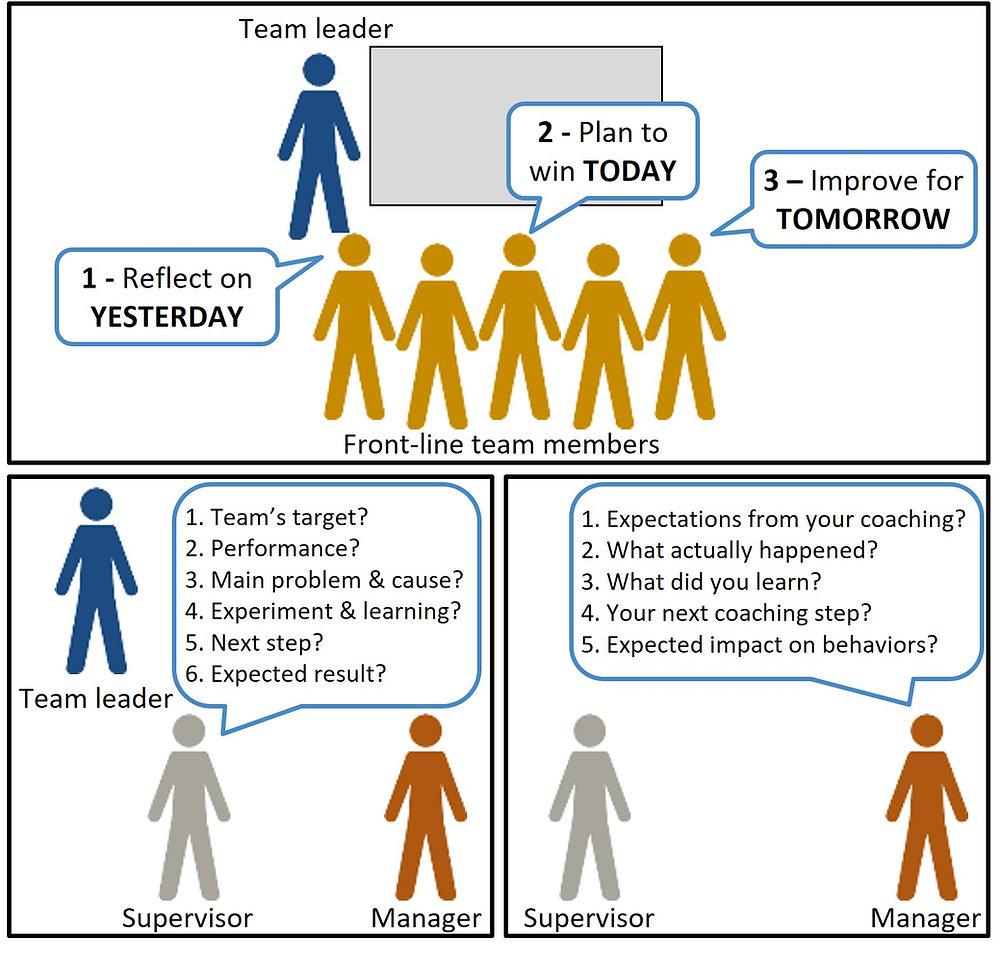
The framework follows a cascading model, where coaching occurs across all levels of leadership. Each layer of the organization both receives and provides coaching, creating a continuous cycle of development and support.
1. Team Leaders: Facilitating Daily Huddles
Team leaders are at the front line of the organization, responsible for facilitating daily huddles and leading small teams in structured discussions. Their role includes:
- Reflecting on past performance: Reviewing metrics, issues, and lessons from previous shifts.
- Addressing resource needs: Ensuring teams have the tools, materials, and support to meet objectives.
- Setting the stage for experimentation: Encouraging small tests of improvement and coaching team members through problem-solving.
Daily huddles are not administrative check-ins—they are a behavioral lever, influencing engagement, accountability, and team learning. Team leaders learn to balance focus on operational priorities with fostering curiosity, collaboration, and structured problem-solving.
2. Supervisors: Coaching Team Leaders
Supervisors play a dual role: managing operational performance while developing the next layer of leaders. Their coaching focuses on:
- Facilitation skills: Helping team leaders run huddles that are efficient, engaging, and outcomes-driven.
- Team dynamics: Observing interactions, addressing conflicts, and fostering psychological safety.
- Driving meaningful improvement: Ensuring that huddles result in actionable insights and problem-solving, not just reporting.
By coaching team leaders in real time, supervisors build leadership capability while improving overall team performance. Their guidance ensures that daily huddles reinforce the desired behaviors and create visible impact.
3. Managers: Coaching Supervisors
At the manager level, the focus shifts from operational execution to developing coaching skills and strategic thinking in supervisors. Managers guide supervisors on:
- Refining coaching techniques: Asking the right questions, providing constructive feedback, and modeling reflection.
- Building stronger team leaders: Ensuring the cascading effect of development reaches the front line.
- Supporting a culture of problem-solving: Aligning coaching with organizational goals and continuous improvement priorities.
Managers act as both coaches and role models, embedding leadership standards into everyday routines and reinforcing the organization’s values.
Why Leaders Coaching Leaders Is Critical
Implementing a structured coaching framework has tangible benefits for organizations:
1. Enhance Leadership Effectiveness
Leaders continuously refine their ability to guide, inspire, and develop their teams. Coaching provides both feedback and insight, accelerating capability development across all levels.
2. Strengthen Problem-Solving at Every Level
When coaching is integrated into daily routines, teams become proactive in addressing challenges. Leaders model structured problem-solving, data-driven thinking, and experimentation, creating a culture where learning is continuous and systemic.
3. Build a Self-Sustaining Improvement Culture
A cascading coaching framework ensures that learning and development are ongoing, not episodic. As leaders coach their peers and teams, capability grows organically, reinforcing a culture of improvement that sustains itself over time.
4. Improve Engagement and Team Performance
Employees at all levels feel supported, empowered, and equipped to contribute their best work. Visible coaching and mentorship build trust, strengthen relationships, and foster accountability, leading to higher morale and more effective teams.
Implementing the Leaders Coaching Leaders Framework
Successfully integrating this framework requires intentional design and disciplined execution. Key steps include:
1. Make Coaching a Daily Habit
Coaching must be embedded into the workflow, not treated as an occasional event. Structured coaching sessions should:
- Occur in real time, at the point of work.
- Reinforce specific behaviors or skills.
- Be concise, actionable, and focused on learning rather than evaluation.
Daily engagement ensures that development is continuous, immediate, and directly tied to operational outcomes.
2. Provide Training on Effective Coaching
Not all leaders are naturally skilled coaches. Organizations must equip leaders with the ability to:
- Ask powerful questions that guide discovery rather than provide solutions.
- Listen actively to understand context and perspective.
- Offer constructive feedback that motivates learning and growth.
- Facilitate reflection and experimentation to reinforce structured problem-solving.
Training ensures coaching is consistent, effective, and aligned with organizational standards.
3. Ensure Accountability and Feedback Loops
Coaching effectiveness must be measured and refined. Feedback loops can include:
- Peer observations and coaching reviews.
- Reflection on team outcomes and behavioral changes.
- Metrics tracking the impact of coaching on engagement, problem-solving, and improvement initiatives.
Regular assessment keeps coaching intentional, prevents drift, and strengthens the system over time.
Case Example: Manufacturing Plant Leadership Development
In a mid-sized manufacturing facility, we implemented Leaders Coaching Leaders across three tiers: team leaders, supervisors, and managers. Initially, huddles and problem-solving efforts were inconsistent. By introducing structured coaching:
- Team leaders improved facilitation skills, engaging their teams in meaningful problem-solving.
- Supervisors provided targeted coaching, reinforcing behaviors and ensuring alignment with operational goals.
- Managers observed coaching interactions, providing feedback and modeling best practices.
Within six months:
- Team engagement scores increased significantly.
- Problem resolution speed improved, with fewer escalations required.
- Continuous improvement initiatives became part of the daily rhythm, rather than isolated projects.
The transformation was not due to tools or metrics alone—it was the consistent application of coaching behaviors that drove capability and cultural change.
Case Example: Hospital Leadership Cascades
In a large hospital, leaders introduced a cascading coaching framework to improve patient flow and staff engagement. Nurses, charge nurses, and unit managers participated in structured coaching at their respective levels:
- Team leads facilitated huddles, identifying delays and proposing small experiments.
- Supervisors coached team leads on engagement, structured problem-solving, and escalation practices.
- Managers coached supervisors on developing coaching skills and linking observations to organizational priorities.
The results were striking:
- Average discharge times decreased.
- Staff reported higher engagement and clarity in roles.
- Continuous improvement became embedded in daily operations, not dependent on external consultants or temporary initiatives.
Key Principles for Sustainable Leaders Coaching Leaders
- Coaching Must Be Intentional: Every session should have a clear purpose, whether it is skill development, problem-solving, or reflection.
- Embed in Daily Work: The most effective coaching happens in real time, integrated into the flow of operations.
- Cascade Capability: Leaders develop leaders, ensuring that skills and behaviors spread throughout the organization.
- Measure and Adjust: Use feedback and observation to refine coaching practices continuously.
- Reinforce Culture: Coaching should support the organization’s values, strategic priorities, and commitment to improvement.
Conclusion: Coaching as a System Driver
Leaders Coaching Leaders is more than a training framework—it is a system for building capability, sustaining engagement, and embedding continuous improvement. By structuring coaching across all levels, organizations:
- Strengthen leadership skills systematically.
- Enhance team problem-solving and operational performance.
- Create a self-sustaining culture of learning and improvement.
Ultimately, leadership development is not a project to complete—it is a daily, intentional practice. When leaders actively coach and develop one another, they reinforce behaviors, align actions with organizational goals, and ensure that improvement is woven into the very fabric of the organization.
By embracing this framework, organizations move from isolated development efforts to a living system of growth, where every leader contributes to building stronger, more capable teams—and where improvement truly becomes the way work gets done.
Comments